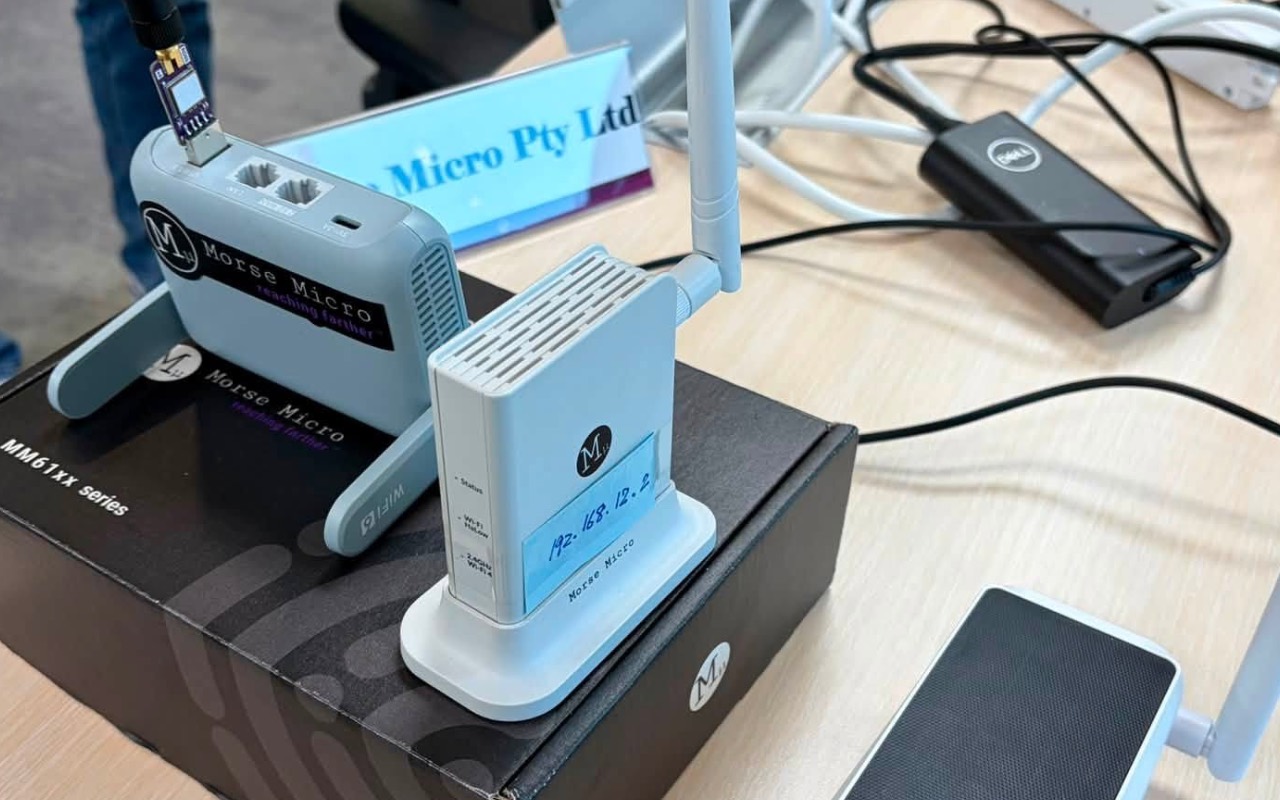

SaiJai Tech explored long-range Wi-Fi HaLow solutions for future AIoT, smart city, and disaster management applications in Thailand.
On July 3, 2026, an executive from SaiJai Tech Co., Ltd. participated in a knowledge-sharing and technology study visit focused on Wi-Fi HaLow, based on the IEEE 802.11ah standard, at NTT e-City Labo within the NTT Central Training Institute in Chofu, Tokyo, Japan.
The visit provided an opportunity to learn about the latest technologies and solutions from experts representing NTT, KYOCERA, Wi-Fi Alliance, the 802.11ah Promotion Council (AHPC) Japan, and other industry partners. Participants also exchanged perspectives on how wireless connectivity can support urban infrastructure and public services.
The program introduced NTT e-City Labo and several technology applications, including Wi-Fi HaLow and νLab, municipal multi-purpose networks, disaster prevention, digital inspection, ICT-enabled urban farming, digital twins, autonomous driving, smart poles, and NTT’s IOWN concept.
Wi-Fi HaLow operates in sub-1 GHz spectrum and is designed to provide extended coverage, improved signal penetration, and energy-efficient connectivity for IoT devices. These characteristics make it suitable for wide areas and locations where conventional network infrastructure may be difficult or costly to deploy.
SaiJai Tech was particularly interested in the use of Wi-Fi HaLow for disaster prevention and management. The technology can connect sensors, cameras, and other field devices across remote or geographically dispersed locations, allowing operational data to be transmitted to central platforms for monitoring, analysis, and early-warning support.
For local communities, potential applications include monitoring water levels, rainfall, weather conditions, wildfire risks, and infrastructure abnormalities. Faster access to field information can improve preparedness, provide more time to respond, and support better decisions during emergencies.
Wi-Fi HaLow also has potential across a wider range of smart city applications, including environmental monitoring, smart agriculture, energy management, asset tracking, and connected infrastructure. Its long-range capabilities can reduce network deployment complexity and enable field devices to exchange data more consistently.
The SaiJai Tech executive was one of two participants from Thailand invited to join the program. The visit enabled the company to learn from practical implementations in Japan while building connections with experts and partners in the international Wi-Fi HaLow ecosystem.
The knowledge gained will inform SaiJai Tech’s plans to explore Wi-Fi HaLow deployment in Thailand, supporting AIoT systems and intelligent infrastructure, particularly solutions for disaster monitoring, early warning, and emergency management that require reliable connectivity across wide areas.
This study visit forms part of the company’s technology readiness and international collaboration efforts, with the aim of adapting relevant knowledge and solutions to local conditions and community needs in Thailand.